27 October, 2010

Poet of the Week - William Blake


This week we have chosen to read some poems by William Blake. He wrote some beautiful poems for children. This is one I love:


The Lamb

Little Lamb, who made thee?
Dost thou know who made thee,
Gave thee life, and bid thee feed
By the stream and o'er the mead;
Gave thee clothing,
woolly, bright;
Gave thee such a tender voice
Making all the vales rejoice;
Little Lamb, who made thee?
Dost thou know who made thee?

Little Lamb, I'll tell t
hee.
Little Lamb, I'll tell thee.
He is called by thy name,
For He calls Himself a Lamb:-
He is meek and He is mild;

He became a little child.
I a child, and thou a lamb,
We are called by Hi
s name.
Little Lamb, God bless thee;
Little Lamb, God bless thee.


The poem is taken from Anthology of Best-Loved Poems, selected by Andrew Lang.
It is a lovely hardcover book with poems by many of the great poets:


18 October, 2010

Drawing DVD pics


We enjoyed another lesson with Graham Braddock via his wonderful DVD last week. The latest lesson was how to draw a still life picture. We were all pleased with the results!


Top left: Ainsley (8yrs), top right: Me (30+yrs), bottom left: Bethany (12 yrs) and bottom right: Emily (10 yrs). Ainsley was allowed to use a layout guide, but the rest of us were on our own (apart from Graham's exceptional instruction of course!)
Posted by Picasa

15 October, 2010

Book Review: One Hand, Two Hands by Max Lucado, illustrated by Gaby Hansen


I have recently signed up with Booksneeze, to recieve free books for review on my blog.

After a few weeks of waiting, our first book finally arrived. It appears that somehow the small detail of our country of abode had missed the address on the box! The book went all the way to Japan, but eventually managed to find its way to us here in New Zealand!

One Hand, Two Hands is a gorgeous, hardcover book written by Max Lucado. Aimed at pre-schoolers, the book tells about how little hands can used practically in everyday life, then goes on to give suggestions on how little hands can be used to bless others, thereby also glorifying God. Written as a poem, it lends itself to memorisation:

"Button your shirt. Tie your own shoe.

Play in the band! Do-dee do-dee-do!"

and

"One hand, two hands, five fingers, ten...

God, thanks for my hands. Please, use them again."

The watercolour illustrations by Gaby Hansen are just beautiful. This book would make a great gift for a pre-schooler; my littles really enjoyed this book, and I'm sure it will become a favourite read aloud.

Disclaimer: Booksneeze have sent me a complimentary copy of this book. I am under no obligation to publish a positve review, and the opinions expressed are entirely my own.

14 October, 2010

Poetry a la Dr. Suess


To those who have had copious instruction,
I am sure Dr. Suess needs no introduction!
Last week we were privileged to view for our pleasure
Many of Dr. Suess's prints, at our leisure.
We travelled by car - a short expedition,
To Woodville, to see this great exhibition.
We thought that an opportunity like this
We would be very sorry and silly to miss!

Enough of that! The exhibition was fun to visit, rather like looking at giant pages out of Dr. Suess's books hanging on the wall. There were also what he calls "unconventional taxidermy" - sculptures of some of the strange creatures he invented.

Along with the exhibition the local library is running a poetry competition. here are the girls' entries:


Skandagupta Clovis

by Emily


Skandagupta Clovis is a funny sort of man,

He went with Marco Polo, to see a far-off land.

He travelled with Mansa Musa, to Mecca and back again,

For he was indeed in charge of all the great king's men.

He helped William Caxton write his book of chess,

In the Wars of theRoses, he fought with the rest.

Oh Magellan's ship he sailed, to discover India at last!

He was one of the lookouts, high up on the mast.

Then he settled down in Brazil, where he works at a mill,

And he lives there happily still.

The End.


Dixie Cook

by Bethany


Dixie Cook was a cook.

Dixie Cook was a rook.

Dixie Cook was a rook who could cook.

Dixie Cook cooked for the King.

Thrice every day the King would ring

A bell for his favourite snack.

Herb-sprinkled, sun-dried, smoked lamb rack.

He ate it for breakfast, for dinner and tea.

In the morning, at night, whenever, really.

At last Dixie Cook made a decision.

“Lamb rack, O King, is bad for your vision.

Why not eat something different instead?”

The King was having breakfast in bed.

He threw back the bed-clothes.

“Certainly, Cook! You are a very intelligent rook.

Make a new dish in time for my dinner!”

Dixie set to work. It had to be a winner.

She mixed up a pie made of beef and cheese.

Lettuce and breadcrumbs and lemon and peas.

The King ate the pie. He let out a sneeze.

“Dixie Cook! This won’t do! Disgusting! Please

Cook something different without any cheese.”

Dixie Cook mixed a soup, with vegetables and meat.

She tasted it. It was tangy and sweet.

The King sipped the soup. His face went green.

“Horrible! Awful! Disgusting! How mean!

You meant to poison your King and your Queen!

Guards, take Dixie away! You’ll stay in prison

For a year and a day!”

Poor Dixie. In prison, she thought very hard,

Then sent the King an apology card.

The King sent one back to Dixie Cook,

It read, “To Criminal Rook Dixie Cook,

You’ll be freed if you can do as I say.

You have a whole year and one day.

Think of a dish that I would like.

Call it Super Extreme Delight.

Cook it and send it to me,

And I will eat it for afternoon tea.

Dixie Cook was a brilliant rook,

So she thought for a year, very hard,

Then sent the King the dish and a card.

The King ate the dish, “Fantastic!” he cried.

“It’s super! It’s brilliant! It can’t be denied!

Guards, release Dixie cook. She’s a very clever rook!”

He rewarded her with a golden crown.

She became the Head Cook in the town.

Many years later, the King still likes

Eating the Super Extreme Delight.

But once when he rang for his favourite snack –

“If you don’t mind, can I have some lamb rack?”

27 September, 2010

Lessons from Jane Eyre


Image from the 1996 BBC miniseries of Jane Eyre

I have recently, for the first time in my life, finally read Jane Eyre. Needless to say, I loved it, and have learned a lot from it. I would like to share part of a conversaton Jane has with her fellow student at the Lowood School, where Jane spent 8 years of her life. Lowood School was a "charitable institution", but the girls were not well fed and the buildings were never heated satisfactorily. Some teachers were kind, others were harsh. This is an excerpt of a conversation between Jane and her friend, Helen Burns, shortly after Helen had been harshly punished for her "faults":

"You must wish to leave Lowood?" [Jane]

"No! why should I? I was sent to Lowood to get an education; and it
would be of no use going away until I have attained that object." [Helen]

"But that teacher, Miss Scatcherd, is so cruel to you?"

"Cruel? Not at all! She is severe: she dislikes my faults."

"And if I were in your place I should dislike her; I should resist
her. If she struck me with that rod, I should get it from her hand;
I should break it under her nose."

"Probably you would do nothing of the sort: but if you did, Mr.
Brocklehurst would expel you from the school; that would be a great
grief to your relations. It is far better to endure patiently a
smart which nobody feels but yourself, than to commit a hasty action
whose evil consequences will extend to all connected with you; and
besides, the Bible bids us return good for evil."

"But then it seems disgraceful to be flogged, and to be sent to
stand in the middle of a room full of people; and you are such a
great girl: I am far younger than you, and I could not bear it."

"Yet it would be your duty to bear it, if you could not avoid it:
it is weak and silly to say you CANNOT BEAR what it is your fate to
be required to bear."

I heard her with wonder: I could not comprehend this doctrine of
endurance; and still less could I understand or sympathise with the
forbearance she expressed for her chastiser. Still I felt that
Helen Burns considered things by a light invisible to my eyes. I
suspected she might be right and I wrong; but I would not ponder the
matter deeply; like Felix, I put it off to a more convenient season.

--from Jane Eyre by Charlotte Bronte, Chapter 6, here.

What a great example of bearing up under adversity! Jane is later put to the test when she is falsely accused of being a liar, and made to stand on the stool for hours.

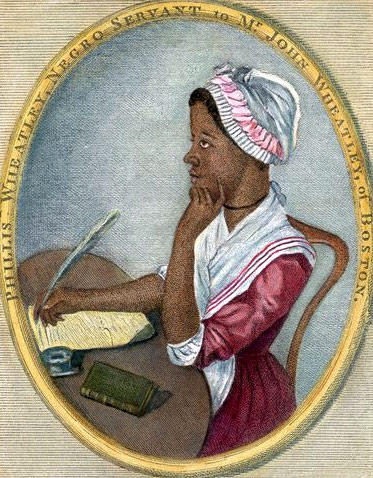
Phyllis Wheatley by Ainsley

Here is Ainsley's narration on Phillis Wheatley:

Phillis Wheatley

by Ainsley (8 years)

Phillis was born in Africa and captured when she was 8 years old. She was sold to an American tailor in Boston (his name was John Wheatley).Phillis became attached to the tailor's wife immediately after she became her servant. Mr & Mrs Wheatley had two children called Mary and Nathaniel (they were twins). Phillis got her name from the ship she went in from Africa to America, she got her last name from the Wheatleys. Her first book was "Poems on Various Subjects, Religious and Moral," and was printed in London. When Phillis returned from her trip to London the Wheatleys freed her and she stayed living with them. Mrs Wheatley died in March of 1774. In 1778, Phillis's tutor, Mary Wheatley and her father John Wheatley died and Mary's twin Nathaniel was living overseas in England. That same year Phillis married a free black Bostonian named John Peters. Phillis dies on December 5, 1784 at about the age of 30 and her baby passed away a short time later. And that is the story of Phillis Wheatley.


17 September, 2010

Poet of the Week - Phillis Wheatley

This week we are looking at the poems of Phillis Wheatley. We have been learning about the early settlers to the New World in our history, and this week's lesson was about the first slaves brought to America.


Phillis Wheatley was one of those slaves. Here are some narrations the girls have written about her life.


Phillis Wheatley

by Emily

Born in around 1753 in Africa, Phillis Wheatley was the second woman in America to publish poems. At the age of eight, she was captured to be a slave, and a Boston tailor, Mr. John Wheatley, bought her. After learning the English language in just sixteen months, Phillis wrote her first poem, an elegy, when she was thirteen. It was called "On the death of the Rev. Mr. George Whitefield." In 1770 Phillis published her first poems. She wrote many poems describing her being brought to America from Africa. When Mr. & Mrs. Wheatley died, Phillis was released and married a freed black man, John Peters. Two of her three children died in infancy, and in 1784, when she was thirty-one, Phillis and her last child died in poverty.


Phillis Wheatley

by Bethany

Phillis Wheatley was named after the ship that took her from Africa to America. She took the last name of Wheatley from the people who bought her. Phillis was eight when she became a sevant to the Wheatleys. She wrote lots of poems and elegies. Before they could be published, she had to go to London and have several men's signatures on her work to show that she had actually written it. When she grew up, she married another African-American called John Peters. Two of her three children died, and at thirty-one, Phillis too died.

Phillis Wheatley

by Ainsley (8 years)

Phillis was born in Africa and captured when she was 8 years old. She was sold to an American tailor in Boston (his name was John Wheatley). Phillis became attached to the tailor's wife immediately after she became her servant. Mr & Mrs Wheatley had two children called Mary and Nathaniel (they were twins). Phillis got her name from the ship she went in from Africa to America, she got her last name from the Wheatleys. Her first book was "Poems on Various Subjects, Religious and Moral," and was printed in London. When Phillis returned from her trip to London the Wheatleys freed her and she stayed living with them. Mrs Wheatley died in March of 1774. In 1778, Phillis's tutor, Mary Wheatley and her father John Wheatley died and Mary's twin Nathaniel was living overseas in England. That same year Phillis married a free black Bostonian named John Peters. Phillis died on December 5, 1784 at about the age of 30 and her baby passed away a short time later. And that is the story of Phillis Wheatley.


Phillis had a strong faith in God, and this was the basis for most, if not all, of her poems. The following poem was written regarding her being brought to America as a slave.

On Being Brought from Africa to America

'TWAS mercy brought me from my Pagan land,

Taught my benighted sould to understand

That there's a God, that there's a Saviour too:

Once I redemption neither sought now knew,

Some view our sable race with scornful eye,

'Their colour is a diabolic die.'

Remember, Christians, Negroes, black as Cain,

May be refin'd, and join the angelic train.

We all enjoyed reading Phillis's poem about David and Goliath. Here is an excerpt where she describes Goliath:


"When from the camp of the Philistine foes,

Dreadful to view, a mighty warrior rose;

In the dire deeds of bleeding battle skill'd

The monster stalks the terror of the field.

From Gath he sprung, Goliath was his name,

Of fierce deportment, and gigantic frame:

A brazen helmet on his head was plac'd,

A coat of mail his form terrific grac'd,

The greaves his legs, the targe his shoulders prest:

Dreadful in arms high-tow'ring o'er the rest

A spear he proudly wav'd, whose iron head,

Strange to relate, six hundred shekels weigh'd;

He strode along, and shook the ample field..."


~ Phillis Wheatley, Goliath of Gath, Samuel chapter 17.

You can read the rest of the poem here.


A free PDF download of Phillis's poems can be found at Poem Hunter.com.


Related Posts Plugin for WordPress, Blogger...