Showing posts with label history. Show all posts

09 September, 2011

Vive Les Roses!

We have just finished learning about the French Revolution in Story of the World 3: Early Modern Times by Susan Wise Bauer.
One of the extra reading suggestions was "The Man who Painted Flowers" by Carolyn Croll.


It looks like a lovely picture book which I would love to purchase at some stage. Carolyn Croll has several of her lovely illustrations on her blog, which is well worth a look at.


I did however come across a very similar sounding book on
trademe. It is called "The Man who Painted Roses, the Story
of Pierre-Joseph Redoute". So I snapped up this book for just $2, thinking it was bound to have some of Redoute's paintings reproduced in it. I was a little disappointed when I received it as there were no pictures, other than on the front cover. What I did discover however, was a wonderful story of Redoute's life.


Redoute was born about 30 years before the French Revolution, into a family of painters in Belgium. His father longed for he and his brothers to grow up to be famous landscape or portrait painters. They were encouraged to leave the family home at the age of 13, and travel the country learning from master painters, earning their bed and board by assisting the master painters and by painting the odd potrait or religious painting for the local people.


Redoute learned much from this experience, but he never really wanted to paint portraits, he love flowers! He was constantly distracted by their beauty and began to sketch every flower he could along the way.

Eventually Redoute married and settled in Paris. Pierre-Joseph and his wife, Marie-Marthe, had two daughters, Josephine and Adelaide. Through the help of his older brother, Antoine-Ferdinand, and the contacts of various well-known French botanists, Redoute went on to be the official painter for Queen Marie-Antoinette, the Empress Josephine (first wife of Napoleon Bonaparte), the Empress Marie-Louise (second wife of Napoleon) and Queen Marie Amelie. If you can keep up with all the Maries, Louises and Josephines in the story, you are doing well!

Redoute published many botanical books on roses, lilies and many other flowers of the world. He lived a full life and died at the age of 81.

I learned more French history in this book than I have ever known!

19 April, 2011

A Living Bookshelf


A living book is a book that opens your mind, inspires you to read more, or to learn more about a person, event, or time in history. A living book will ask to be read again, or quoted from as you read through it. A living book will be re-enacted by your children in the backyard or the living room theatre. A living book will sprout ideas for a new project or writing lesson.

Many of you are aware of the great booklists - especially Ambleside Online's booklists. These lists have been the backbone of our read-aloud books over the years.

But we have also come across many books that are not on those lists. I would like to share a little bit about some of the books sitting on my bookshelf in the picture.

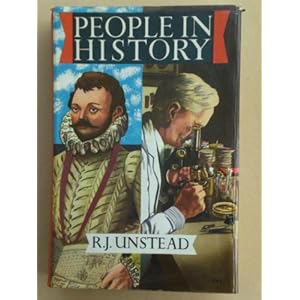
Nestled between the big Matthew Henry commentary on the book of Matthew, and one of the girls' Bibles, is a red & black book called "People in History" written by R.J. Unstead. This is what he writes in his introduction:


Every age has its heroes who stir the imagination and shape the lives of ordinary people. For a child in particular, tales of heroism and adventure, of high courage and achievement, are an important and essential part of his development, as well as his first introduction to history.

Unstead then goes on to "tell the stories" of many historical characters, from Boadicea, to William the Conqueror, to Florence Nightingale. The stories are accompanied by black and white, and some colour illustrations. Unstead has written many other books on different time periods, and they are always a delight to read.

Another book on the shelf - infact a set of books, are those by Arthur Mee. They are the red and green books, three of which are without dustjackets, toward the right hand end of the bottom shelf. One of them is called "The Wonderful Journey". This is Arthur Mee's introduction:

Here we will let imagination do its work; we will roam among the great sights of the world. This is no guide-book. It is a picture of things that a busy man has seen when he has found the courage and the time to say Good-bye to Little Treasure island, and to run over the hills and far away. It is a look-back to happy days and far-off things...


...from this hilltop [in Kent] with all its thrilling wonder, we may pass in not many hours to stand among the ruins of Time and her ancient empires. We can be in Egypt or in Rome. We can walk among the ruins of Pompeii, and look upon the monuments the Romans left behind. Within a week we can stand in the heart of a mountain and gaze on the face of Pharoah lying where his people left him long ago. We can see the shadows of their mighty walls creep across the sands of Egypt. Let us imagine we are there again. Let us go together on this journey through Time and some of her wonders.

"A Wonderful Journey" is another book that tells the stories of historical characters, but also makes you feel as though you have been to all the places and seen the characters!
Arthur Mee also wrote a children's newspaper, about all manner of different subjects. They were eventually published as "The Children's Encyclopaedia", which we have a copy of. The girls spend hours pouring over these books!

I always look out for these two authors, because I know they will not disappoint!

13 August, 2010

Stained Glass Window Art

We finally got around to finishing our "stained glass windows". We did this craft to go along with a medieval history lesson, but it also tied in with some of our art studies. Thanks to Dana's and Barb's wonderful posts we found some great patterns at Chantal's Stained Glass website to use for our "windows."

We printed out the patterns onto regular printer paper, then traced them onto tracing paper. The pad of tracing paper was much cheaper to buy than acetate pages, which probably would have been better.


Next we drew over the patterns with black PVA glue. This was trickier than it looks. The glue tended to come out of the tube in an irregular fashion, but I think it added a bit of originality to our designs. We laid them out to dry. We didn't get around to finishing them until this week, because I needed to purchase some white glue to stain with watercolours, so that we could colour in the designs. Spot the Mondrian on the bottom!


Well, it turned into one of those things that sat around unfinished, until I found some cheap coloured glue sticks at the local Warehouse store.

The girls got them out earlier this week and finished them off. Needless to say it was a messy job, but they look beautiful hanging up on the window. Here are some of the girls' designs. One day I might get around to finishing my Mondrian style design.


11 February, 2010

1066


Here's a quick question for all you history buffs out there:

What happened in England in 1066?

That's right - the Battle of Hastings, when William the Conqueror from Normandy successfully invaded England and defeated King Harold.


The Bayeux Tapestry was a huge embroidery made depicting the events surrounding and including the Battle of Hastings. It is an amazing work of art.


Well, here in little old New Zealand, a keen historian has re-created the Bayeux Tapestry - but it is not a tapestry, it is an amazingly intricate mosaic made up of the most unlikely material.


Michael Linton and his daughter, Rachael, completed their mosaic copy of the Bayeux Tapestry using tiny pieces of spring steel - the offcuts from patterning disks used on a very large industrial knitting machine. The pieces are approximately 7mm square. The mosaic took Michael & Rachael 25 years to complete and is almost 34 metres long. It is currently displayed in Michael and Gillian's shop, "The Giant Jersey", in Geraldine, in the South Island of New Zealand.


Well, my parents have just been on a holiday in the South Island and brought back a set of amazing CD-roms with a wealth of information about the Bayeux Tapestry and the surrounding events. There are high resolution scans of the mosaic, scene by scene descriptions, a comprehensive study of the history of the tapestry, activities and games for the kids, as well as a large library of related books - including hundreds of Aesop's fables, Our Island Story and many more! There are also images of beautiful illuminated manuscripts, medieval hymns along with their music as well as poems about the events and much more. It is going to provide us history nuts with hours of fun & enjoyment!
Check out Michael's website for more information and pictures of the mosaic - oh, and the "Giant Jersey"!

*********************

UPDATE APRIL 2012!  Please visit Dana's blog to see an animated version of the tapestry, it's great!

05 November, 2009

A Light-hearted Take on King Henry VIII

Today for her English, Emily had to write a poem - either funny or serious. Discussion ensued on what she could write about. Bethany was in the middle of a report on King Henry VIII's wives, so I suggested Emily write a limerick about him.

This is what she came up with:


Henry's Wives

by Emily

Two of the wives of Henry the VIII

Had a very fatal fate (beheading)

Two of them were forced,

at the King's command to be divorced.

Then one had died,

and one survived,

and that was the end of the wives.

~ all because he wanted an heir!

Silly Henry!

~~~~~~~~~~~~~~~~~~~


18 October, 2009

Gutenberg's Printing Press


Today in Story of the World, we learned about the beginning of the Renaissance, and how Johannes Gutenberg invented the printing press.


Here us a Youtube video explaining how the printing press worked:

Demonstrating the Gutenberg Printing Press

This is a post by Jeanne at A Peaceful Day about a beautiful pop-up story book of Gutenberg.

~~~

Bethany's Narration:

Johannes Gutenberg made a printing press from an old winepress. He stamped the letterblock with ink made from soot and linseed oil, and put it in a type of folder. Then he turned a wheel and a lever to flatten it, squeezing the paper and the block together. Then he turned the wheel back to push the folder back and took the paper out. On it would be printed the words that were on the letterblock.

~~~

Emily's Narration:

His printing press worked like this: taking raw cow hide leather he soaked it in cow wee overnight then rinsed it by hand. Then using ink made of linseed oil and soot, and a roller, he rolled the ink onto the leather. (This refers to the "pounders" he used to pound the ink onto the letterblock).

Next he carefully placed a piece of paper in a folder-like thing called a frisket. He placed the inked leather on his machine. He then rolled the frisket with the paper in it over the leather and turned a lever to press the ink onto the paper.

On the youtube video the man demonstrating printed a page of the Gutenberg Bible. It had a space left for when it got illuminated and illustrated. For Monks writing book by hand it would take years to print the entire Gutenberg Bible. Johannes Gutenberg and twenty helpers printed 450 Bibles in one year. The very first book he printed was the Gutenberg Bible.


~~~


Gutenberg is credited with printing the first Bible. He also printed paper indulgences, sold by the Roman Catholic church to pardon the buyer from of his sins. This is what sparked Martin Luther's Ninety-five Theses, which where 95 reasons why the church should not sell indulgences. Luther had studied the book of Romans which convinced him that God promises forgiveness to all who repent and believe in Jesus Christ as their Saviour.

~~~

Here is a picture of a page from one of Gutenberg's Bibles:


~~~


Gutenbergprinted the text, leaving a blank space for the illumination of the first letters of a chapter. The illumination and decoration was completed by monks.


~~~~~~~~~~~


24 November, 2008

Travelling the Silk Road

This morning we had another History lesson, which hasn't happened in a long time! Our dear friends with whom we used to get together for History and IEW lessons have packed up and moved to North Dakota, where my friend is originally from. We will miss them dearly, but we will carry on alone, sniff sniff! We are using Story of the World Volume 2: The Middle Ages. Today's lesson was about Marco Polo, the explorer to China who travelled the Silk Road along with his father, Niccolo.

So, don your paper bag Chinese hat and come along with us:


First up, we must pass through the hot and treacherous Taklamakan Desert:


We'll stop for a rest on a comfy chair and enjoy a snack at the oasis of Tun-huang-shih:


We must now pass south of another desert, the Gobi Desert:


The Gobi Desert is not so treacherous, it has some oases along the way, so let's stop and have a glass of water.

We'll take a rest and have another snack at Loyang-shih.


Now we'll take the Yellow River to Peking:


In Peking, we can trade for Chinese goods:


and visit the Emporer, Kublai Khan in his palace:


Here we will find gold, ivory, silk and exotic animals.

We'll relax here and then return home to Italy.

It'll take us about four years ;-)


Hope you enjoyed the journey with us. Thanks Susan Wise Bauer, we are loving the Story of the World!


~~~~~

Related Posts Plugin for WordPress, Blogger...